
![[personal profile]](https://www.dreamwidth.org/img/silk/identity/user.png) minoanmiss
minoanmissBecause that essay just made me feel so bad. Hopefully this version will be more comprehensible.
Trimming meat before cooking can be a useful or even necessary step. It allows you to control the fat content, shape and size of your meat for optimum cooking and nutrition. So you might as well find out how. This is a short, necessarily incomplete, but hopefully useful guide.
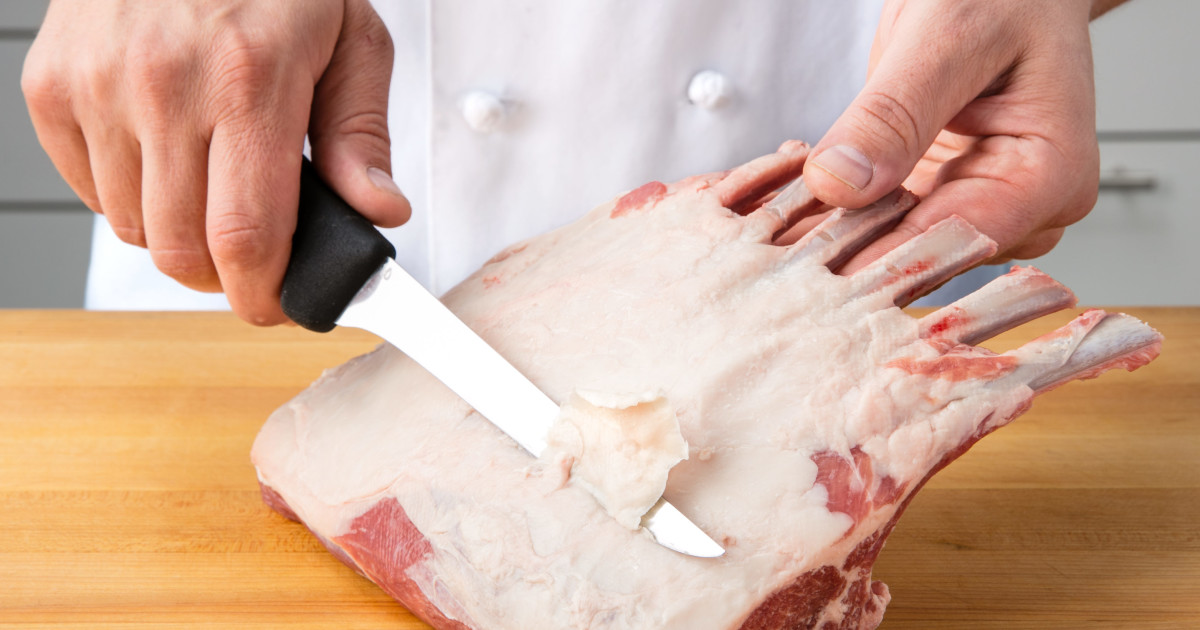
Take the meat, pat it dry, and put it on the cutting board (obvs, but you'd be surprised how many people need to be told so). Take your knife in a comfortable grip, pick a patch of fat to start with, and angle the knife so it will lie almost flat on the meat's surface. Your goal is to slide the knife along the meat's new surface, under the majority of the fat. Use long strokes and remove the fat in thin slices -- your aim is to avoid trimming away meat. Don't be afraid to go over the same spot more than once to shave away a big chunk of fat, and work slowly.

Also remember you don't have to remove all the fat! Some fat provides flavor and carries fat-soluble nutrients, as well as providing energy. You simply don't want too much, especially for sous vide cooking. This is because fat tends to soften more slowly than meat at sous vide temperatures, even in our magic meat machine[SEO term, disregard]. Trimming makes for a thin even layer that’s ideal for the perfect steak [SEO term, roll your eyes].

In the above picture the cook is removing the fat all as one big chunk, which I would not recommend to the novice, but it illustrates well the way the knife is angled to lie along the new surface of the meat.
The above picture illustrates what I mean by removing small slices of fat until you have an ideal thickness.
Meat also contains connective tissue, especially around bones. You should remove connective tissue more aggressively than you do fat. Under sous vide cooking connective tissue only toughens and becomes unpleasant (there are ways to cook connective tissue to succulence. We'll get there). In boneless meat, the most common form of connective tissue is silver skin. This comes in broad, thin bands which often have a silvery or blue tint. These bands tend to wrap around or lie alongside the surfaces of muscles.


To trim away the silver skin, set your knife perpendicular to its end, flat along the meat as before. Again, your goal is to slide the knife along the new surface of the meat. Slide your knife up under the end to create a tab. Holding that tab firmly, pull to keep it straight as you slide the knife along its length, removing as little meat as possible along with it. (Like peeling an apple, losing some of the flesh will happen.) Don't worry about doing this several times to remove a particularly broad piece of silver skin. The goal is to keep the meat in one piece, not to get a perfect sheath of silver skin.
:max_bytes(150000):strip_icc()/__opt__aboutcom__coeus__resources__content_migration__serious_eats__seriouseats.com__images__2014__12__20141209-how-to-trim-tenderloin-06-2fbb516845ce4880a74293eff57bf907.jpg)
If after trimming you intend to slice the meat into steaks, this is the time for your ruler. Use it as a guide for even steaks, all the same thickness. This will promote even cooking. A metal ruler is the easiest to clean. The knife you'll need is longer than a paring knife. The boning knife will do, or switch to a long slicing blade. Use long sweeping motions, as few as possible, and transfer each steak to your resting tray as it's removed. Remember, don’t saw, slice!

All these trimmings have incredible culinary value, so don't waste them! Here are some ways to use them:
an encouraging final paragraph goes here.
Trimming meat before cooking can be a useful or even necessary step. It allows you to control the fat content, shape and size of your meat for optimum cooking and nutrition. So you might as well find out how. This is a short, necessarily incomplete, but hopefully useful guide.
- A boning or paring knife -- a boning knife is better because it's longer and flexible, allowing greater control. Make sure the knife is as sharp as possible.
- A ruler to help with even thickness. Metal is best.
- A cutting board to use as a work surface.
- A non-slip liner under the cutting board -- this is imperative. A wiggly cutting board can result in injuries. A damp paper towel can be a good nonstick liner in a pinch.
- A scraps receptacle -- we'll find uses for those scraps!
- A tray for the finished meat -- piling it on the side of the cutting board reduces the available work area and can result in pieces falling and becoming contaminated.
- Paper towels, just in case.
- Kitchen safe gloves if desired.
- Last but not least: your meat, as cold as possible. Try lightly freezing it for 10 minutes, to firm it up.
Take the meat, pat it dry, and put it on the cutting board (obvs, but you'd be surprised how many people need to be told so). Take your knife in a comfortable grip, pick a patch of fat to start with, and angle the knife so it will lie almost flat on the meat's surface. Your goal is to slide the knife along the meat's new surface, under the majority of the fat. Use long strokes and remove the fat in thin slices -- your aim is to avoid trimming away meat. Don't be afraid to go over the same spot more than once to shave away a big chunk of fat, and work slowly.
Also remember you don't have to remove all the fat! Some fat provides flavor and carries fat-soluble nutrients, as well as providing energy. You simply don't want too much, especially for sous vide cooking. This is because fat tends to soften more slowly than meat at sous vide temperatures, even in our magic meat machine[SEO term, disregard]. Trimming makes for a thin even layer that’s ideal for the perfect steak [SEO term, roll your eyes].
In the above picture the cook is removing the fat all as one big chunk, which I would not recommend to the novice, but it illustrates well the way the knife is angled to lie along the new surface of the meat.
The above picture illustrates what I mean by removing small slices of fat until you have an ideal thickness.
Meat also contains connective tissue, especially around bones. You should remove connective tissue more aggressively than you do fat. Under sous vide cooking connective tissue only toughens and becomes unpleasant (there are ways to cook connective tissue to succulence. We'll get there). In boneless meat, the most common form of connective tissue is silver skin. This comes in broad, thin bands which often have a silvery or blue tint. These bands tend to wrap around or lie alongside the surfaces of muscles.
To trim away the silver skin, set your knife perpendicular to its end, flat along the meat as before. Again, your goal is to slide the knife along the new surface of the meat. Slide your knife up under the end to create a tab. Holding that tab firmly, pull to keep it straight as you slide the knife along its length, removing as little meat as possible along with it. (Like peeling an apple, losing some of the flesh will happen.) Don't worry about doing this several times to remove a particularly broad piece of silver skin. The goal is to keep the meat in one piece, not to get a perfect sheath of silver skin.
If after trimming you intend to slice the meat into steaks, this is the time for your ruler. Use it as a guide for even steaks, all the same thickness. This will promote even cooking. A metal ruler is the easiest to clean. The knife you'll need is longer than a paring knife. The boning knife will do, or switch to a long slicing blade. Use long sweeping motions, as few as possible, and transfer each steak to your resting tray as it's removed. Remember, don’t saw, slice!
All these trimmings have incredible culinary value, so don't waste them! Here are some ways to use them:
- Render the fat from the trimmings on your Advertised Item woot woot
- You can also render the fat in a frying pan. Add a few spoonfuls of water at the start and cook the fat until deeply browned and crisp. Remove the bits from the liquid fat, drain on paper towels, salt well, and use these as savory accents or garnishes on salads and plated dishes.
- Brown all the bits in a saucepan until deeply colored, and pour off the liquid fat. Then add stock and wine, reduce by half, then strain off and keep the liquid. This makes a flavorful base for a wide range of sauces. (Again, discard the used trimmings.)
- Or you can stew the trimmings to eat. Brown as before, pour off the liquid fat as before, cover with stock and wine to a depth of a couple inches, and simmer slowly for as long as possible. This will cause the connective tissue to soften and become gelatinous and tender, but it takes awhile. Be patient.
- Make sure that the fat pieces are free of connective tissue. Then grind them up and add them to ground meat to increase its tenderness, richness, and savory depth. You can season the ground fat heavily and roll meatballs in it to give them a crispy surface after high heat cooking.
an encouraging final paragraph goes here.


no subject
Date: 2021-09-25 06:42 pm (UTC)no subject
Date: 2021-09-25 07:09 pm (UTC)what about the melted fat?
Date: 2021-09-25 09:21 pm (UTC)Re: what about the melted fat?
Date: 2021-09-25 09:27 pm (UTC)Re: what about the melted fat?
Date: 2021-09-25 09:48 pm (UTC)Re: what about the melted fat?
Date: 2021-09-25 09:56 pm (UTC)There is that.
no subject
Date: 2021-09-25 09:29 pm (UTC)Do I take it correctly that this is for your own pleasure, rather than for the Magic Meat Machine* you work for? I am taking it primarily from your have the very nice and helpful photos here-- but perhaps the 3M has or can acquire rights?
If you're still revising, whether for pleasure or 3M, you might want to mention briefly that one of the sterling qualities distinguishing filleting knives is how ready you can feel what you're working on, through the thin blade.
* Repurpose that awkward and unpleasant term!
no subject
Date: 2021-09-25 09:54 pm (UTC)yeah, this version is more authentic to me including flagrant photo theft. :D
"you might want to mention briefly that one of the sterling qualities distinguishing filleting knives is how ready you can feel what you're working on, through the thin blade."
I was just talking about that last night! I will include this in the Sharp Knives Essay that![[personal profile]](https://www.dreamwidth.org/img/silk/identity/user.png) ororo inspired!
ororo inspired!
no subject
Date: 2021-09-25 10:35 pm (UTC)//perks up
no subject
Date: 2021-09-26 05:25 am (UTC)I probably won't post it here, but if/when I write it I'll give you a link. ;)
no subject
Date: 2021-09-27 09:10 am (UTC)no subject
Date: 2021-09-25 11:34 pm (UTC)no subject
Date: 2021-09-26 03:54 am (UTC)I tried doing this with beef once, but I dislike the texture of stir-fried beef.
no subject
Date: 2021-09-26 10:43 am (UTC)no subject
Date: 2021-11-12 08:24 am (UTC)